Insertion Sort
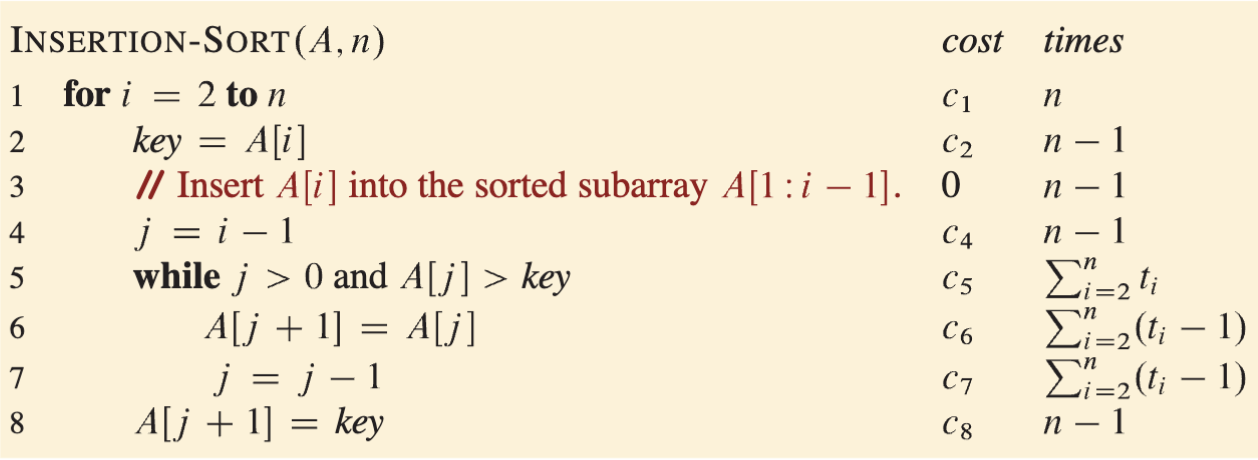
Code
note: the textbook has 1 being the ‘0’ index
def insertion_sort(a, n)
	for i in range(2, n):
		key = a[i]
		# insert a[i] into the sorted subarray a[1: i - 1]
		j = i - 1
		while j > 0 and a[j] > key:
			a[j + 1] = a[j]
			j -= 1
		a[j + 1] = key
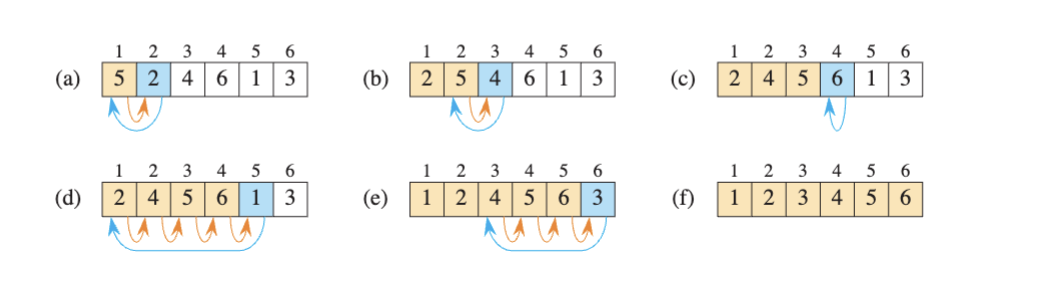
Example
- let’s say we’re given the array,
Loop Invariants
- elements in a[1: i - 1] are known as the loop invariant since these are always sorted. more formally:
- At the start of each iteration of the for loop of lines 1-8, the subarray a[1: i - 1] consists of the elements originally in a[1: i - 1], but in sorted order.
- when using a loop invariant, you need to show three things:
- Initialization: It is true prior to the first iteration of the loop.
- Maintenance: If it is true before an iteration of the loop, it remains true before the next iteration.
- Termination: The loop terminates, and when it terminates, the invariant, usually along with the reason that the loop terminated, gives us a useful property that helps show that the algorithm is correct
Intialization
- We start by showing that the loop invariant holds before the first loop iteration, when The subarray a[1: i - 1] consists of just the single element a[1], which is in fact the original element in a[1]. Moreover, this subarray is sorted (after all, how could a subarray with just one value not be sorted?), which shows that the loop invariant holds prior to the first iteration of the loop.
Maintenance
- Informally, the body of the for loop works by moving the values in a[i - 1], a[i - 2], a[i - 3], and so on by one position to the right until it finds the proper position for a[i], at which point it inserts the value of a[i]. The subarray a[1: i] then consists of the elements originally in a[i : 1], but in sorted order. Incrementing i (increasing its value by 1) for the next iteration of the for loop then preserves the loop invariant.
Termination
Runtime Calculations